
AI Business
AI for HR: How AI Gives HR Teams More Time for People
HR has never been more important. Today’s HR leaders aren’t just responsible for recruitment. They’re shaping culture, improving employee engagement, supporting wellbeing, driving organisational change, developing future skills and helping businesses navigate an increasingly complex world of work.
Yet despite becoming more strategic, much of HR’s time is still spent on administration.
- Recruitment.
- Interview scheduling.
- Policy queries.
- Onboarding.
- Compliance.
- Documentation.
- Employee requests.
None of these are why people choose a career in HR.
The biggest challenge facing HR today isn’t attracting great people. It’s creating enough time to support them.
HR Is Becoming More Strategic, But Administration Is Holding It Back
The workplace has changed dramatically over the last few years.
Employees expect quicker responses, better communication and more personalised experiences throughout their employment. At the same time, organisations are facing skills shortages, changing legislation, hybrid working and increasing pressure to improve productivity without increasing headcount.
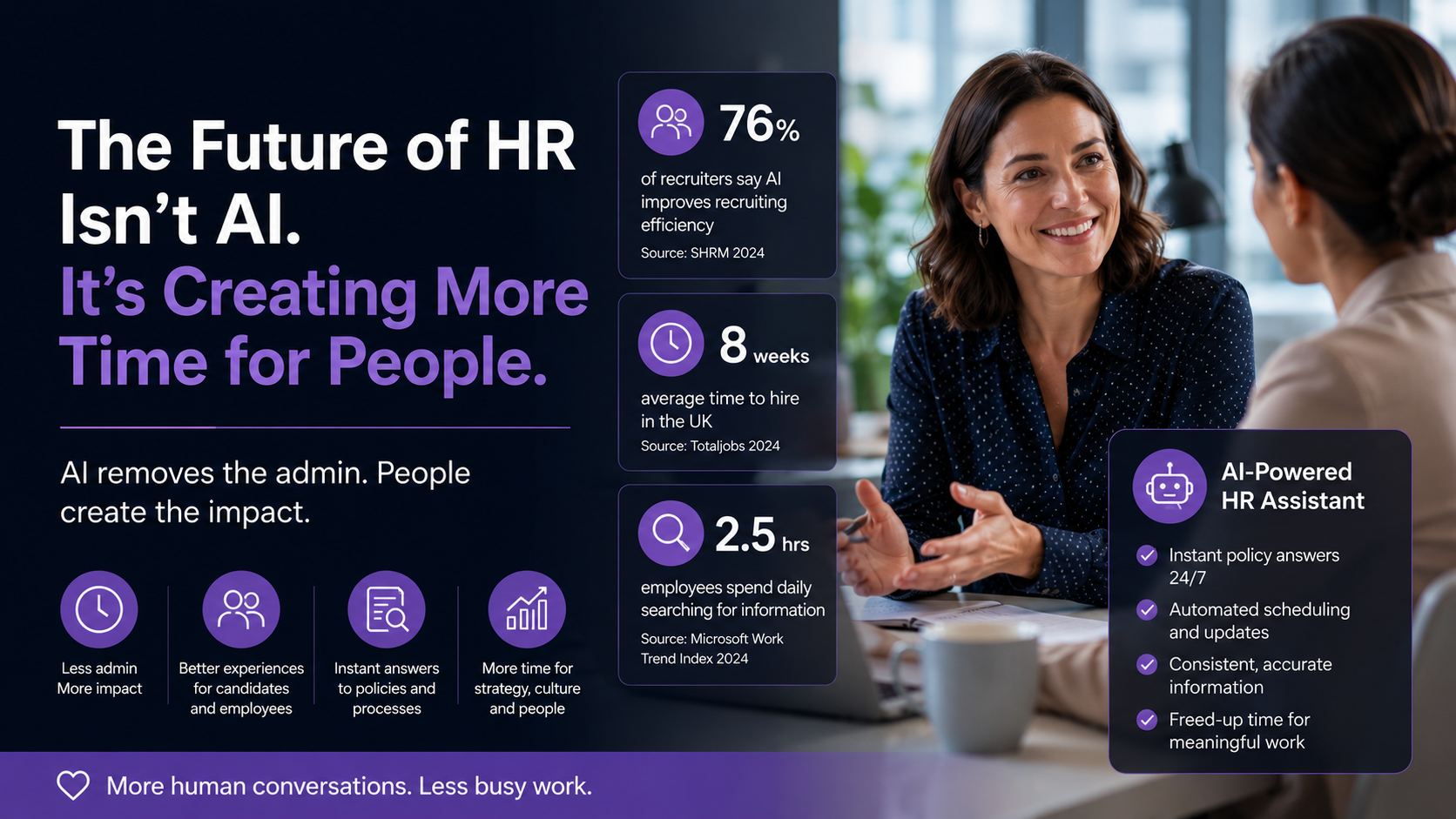
Recruitment has become significantly more competitive too. According to the Office for National Statistics (ONS), UK vacancies have fallen while applications per role have risen sharply, creating greater pressure on HR teams to review, shortlist and communicate with candidates efficiently. Research from Totaljobs also found that the average time to hire has increased to around eight weeks, with larger organisations taking even longer to make hiring decisions.
The result is simple.
HR teams are being asked to do more with the same resources.
Recruitment Isn’t Broken. It’s Overloaded.
Hiring the right people has never been more important.
But every vacancy can now generate hundreds of applications, creating hours of administrative work before a recruiter has even spoken to a candidate.
- Reviewing CVs.
- Scheduling interviews.
- Sending updates.
- Coordinating hiring managers.
- Collecting feedback.
- Managing offer documentation.
Much of this work is essential.
Very little of it requires the expertise that makes great HR professionals so valuable.
This is where AI is beginning to make a real difference.
Not by replacing recruiters.
By removing the repetitive administration that slows recruitment down.
AI can help write clearer job descriptions, identify suitable candidates against predefined criteria, coordinate interviews, answer common applicant questions and keep candidates informed throughout the recruitment journey.
The result is a faster, more consistent recruitment experience that benefits both employers and applicants while allowing HR professionals to focus on what matters most—building relationships and making informed hiring decisions.
Candidate Experience Has Become A Competitive Advantage
Every interaction shapes an employer’s brand.
Candidates increasingly expect clear communication, timely updates and an efficient recruitment process. Long periods of silence, delayed interview scheduling and inconsistent communication don’t just frustrate applicants—they influence how people perceive the organisation.
AI can help maintain momentum by automating updates, interview scheduling and routine communication without removing the personal touch when it matters most.
Technology shouldn’t replace conversations.
It should make more time for them.
One Of HR’s Biggest Productivity Challenges Happens After Someone Is Hired
Recruitment is only the beginning.
Across most organisations, employees spend valuable time searching for policies, procedures and internal information.
- How do I book annual leave?
- Where’s the latest expense policy?
- What’s our parental leave process?
- Which document is the current version?
Too often, the answers are buried inside shared drives, intranets or lengthy documents.
When employees can’t find information quickly, HR becomes the helpdesk.
The same questions are answered repeatedly.
The same documents are sent again and again.
The same interruptions reduce time available for strategic work.
Why Internal AI Assistants Are Changing HR
One of the most practical applications of AI isn’t recruitment.
It’s knowledge management.
An internal AI assistant, trained on your organisation’s policies, procedures and documentation, allows employees to ask questions in plain English and receive instant, contextual answers with links back to the original source material.
Instead of searching for information, employees simply ask for it.
Instead of HR responding to routine queries, teams can find answers themselves.
Knowledge becomes easier to access.
Policies become easier to understand.
Employees become more self-sufficient.
And HR gains back valuable time.
Research from Microsoft’s Work Trend Index consistently highlights that employees lose significant time every day searching for information, switching between applications and responding to interruptions. Reducing that friction doesn’t just improve productivity—it improves the employee experience too.
Human-Centred AI Starts With Trust
The most successful organisations aren’t introducing AI to remove people from HR.
They’re introducing AI to remove friction.
That means being transparent about how AI is used.
Ensuring humans remain responsible for hiring decisions.
Protecting employee data.
Reducing bias through good governance rather than assuming technology is infallible.
Leading organisations are increasingly recognising that successful AI adoption isn’t simply about implementing new tools. It’s about creating confidence, building trust and helping employees understand where AI supports their work rather than replacing it.
The organisations seeing the greatest value from AI are investing just as much in people, policies and adoption as they are in technology itself.
HR’s Future Is More Human, Not Less
For years, technology has promised to make HR more efficient.
AI has the potential to finally make that promise meaningful.
Not because it replaces recruiters.
Not because it automates decision-making.
But because it removes the repetitive work that prevents HR teams from doing the work only people can do.
- Building relationships.
- Supporting employees.
- Developing leaders.
- Creating culture.
Driving organisational change.
That’s where HR creates its greatest value.
And that’s where its future lies.
Three Questions Every HR Leader Should Be Asking
As AI continues to reshape the workplace, it may be worth asking yourself:
- How much of my team’s time is spent supporting people versus managing administration?
- Which repetitive HR processes could be automated without compromising the employee experience?
- If AI gave my HR team back ten hours every week, where could we create the greatest impact?
The answers will be different for every organisation.
But one thing is becoming increasingly clear.
The future of HR isn’t about replacing people.
It’s about creating more time for them.
Explore What’s Possible
If you’re exploring how AI could support your HR function, our complimentary AI Catalyst Workshop for HR is designed to help you identify practical, human-centred AI opportunities across recruitment, employee experience, knowledge management and workforce productivity.
Together, we’ll explore where AI can create the greatest value for your people—while keeping people at the centre of every decision.
Get in touch with Richard.sapsed@cigroup.co.uk.